
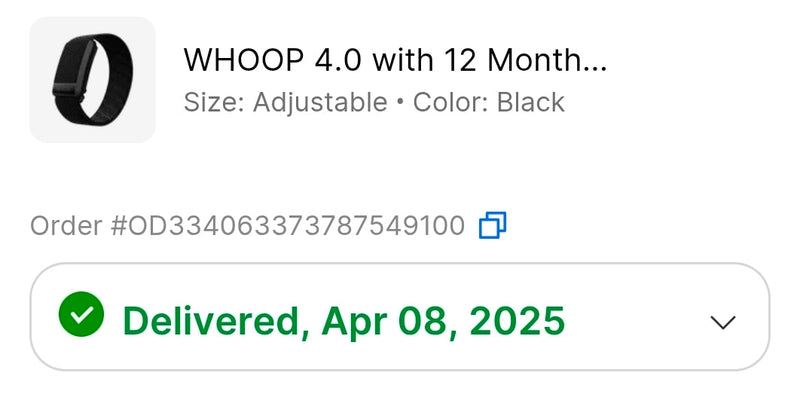
Purchased: 4 April 2025
Purchase price: ₹28,000 from Flipkart
Device reviewed: WHOOP 4.0
Testing period: 12 months
Primary activities: Strength training, occasional running and swimming
Verdict: Useful recovery and sleep insights, but too expensive, demanding and inconsistent for me to recommend to the average user.
Proof of purchase: Flipkart screenshot attached as the article title
I bought a WHOOP on 4 April 2025 for ₹28,000. This was not a review unit, and the brand did not send it to me. I paid for it myself, wore it over the following year and eventually decided not to renew my membership.
That last part probably tells you where this review is going but it is not the whole story.
WHOOP did two things genuinely well for me: recovery and sleep tracking. A good recovery score sometimes gave me the confidence to train harder, while seeing my sleep score every morning encouraged me to go to bed on time. The problem was everything surrounding those useful insights: inconsistent readings, uncomfortable daily wear, too much manual logging and a subscription I could not justify renewing.
After a year, I replaced it with a Garmin.
My WHOOP review in 30 seconds
| Category | My experience |
|---|---|
| Recovery tracking | The most useful part of WHOOP |
| Sleep tracking | Helpful on normal nights, unreliable for me on flights |
| Workout and stress data | Too inconsistent to build much confidence |
| Step count | Frequently appeared 40–50% higher than my comparison count |
| Comfort | Fine initially; irritating in heat, after showers and while swimming |
| Battery | Good |
| Charging | Convenient until I lost the proprietary battery pack |
| App involvement | High—WHOOP works best only if you regularly add context |
| Value for money | Poor for my needs |
| Would I renew? | No |
| Would I buy it again? | No |
Why I bought WHOOP
WHOOP is different from a conventional smartwatch. It does not try to be a miniature phone on your wrist. There is no screen competing for your attention. Instead, it continuously measures your body and turns the data into three main ideas: sleep, strain and recovery.
That proposition appealed to me. I was a regular gym-goer, with some running and swimming mixed in, and I wanted more than a record of workouts. I wanted to know how well my body was recovering and whether I was ready to push harder.
In theory, WHOOP was exactly the product I needed. In practice, using it every day required more patience and involvement than I expected.
The first problem: wearing it continuously
I wore the band regularly for the first two months. Then June arrived, along with the heat, and the skin underneath and around the band began reacting. I cannot establish that WHOOP itself caused an allergy, but I was experiencing enough irritation that I had to stop wearing it temporarily and allow my skin to heal.
After that, I continued using it through the year, but I had to keep shifting it around my wrist. That created two problems. First, something designed for continuous wear had become something I constantly noticed and adjusted. Second, changing its position appeared to interfere with my data at times.
Wearables depend on consistency. If a device becomes uncomfortable enough that you remove it or repeatedly move it, the quality of the long-term picture inevitably suffers. For me, that reduced one of WHOOP’s biggest supposed advantages.
This is, of course, my individual experience rather than proof that everyone will have the same skin reaction. But anyone living in a hot climate should consider whether they will be comfortable wearing a fabric band almost all day and night.
Showering and swimming were unpleasant
WHOOP is meant to stay on your wrist, including during activities where many people would remove a watch. Technically, that sounds convenient. Physically, I disliked it.
Showering with the standard band was a big no for me. The fabric took too long to dry, and having a wet strap against my skin was irritating. Swimming was even worse. Of all the activities I used WHOOP for, the post-swim experience was the least comfortable.
You can remove it before a shower, use another band or buy activity-specific accessories. But those are workarounds—and potentially additional expenses—for a product whose appeal is supposed to be continuous tracking.
Recovery was the one feature I genuinely valued
The recovery score was the strongest part of my WHOOP experience.
On days when I received a high recovery score, I felt more confident pushing myself in the gym. It gave me a simple answer to a useful question: does my body appear ready for a demanding session today?
I would not treat any wearable score as a medical conclusion or allow it to completely override how my body felt. Still, recovery was the metric that most often translated into an actual decision. It was clearer and more actionable than the stream of numbers elsewhere in the app.
This is also where WHOOP is easiest to recommend. A serious athlete planning training loads across a week may extract far more value from recovery trends than someone who simply wants to count steps and record a few workouts.
Sleep tracking helped—but partly because of psychology
Sleep was the other useful part of the experience. Seeing a score each morning made me want to sleep on time and collect better numbers the following day.
That motivation was real, even if it was partly psychological. The tracker turned an abstract intention—“I should sleep earlier”—into a daily target.
However, WHOOP is not the only wearable that can create this effect. A smartwatch, fitness band or smart ring with decent sleep tracking can also encourage better habits. The question is whether WHOOP’s interpretation of your sleep and recovery is worth its recurring membership cost.
Sleep tracking was also unreliable for me during flights. On occasions when I slept on a plane, the band seemed to struggle with what was happening. That was frustrating because travel is precisely when understanding poor sleep and recovery could have been most useful.
The step count was difficult to trust
My biggest accuracy complaint was the step count. In my comparisons, WHOOP frequently recorded totals that appeared approximately 40–50% higher than my actual count.
That is too large a gap to ignore. Step count may not be WHOOP’s headline feature, but once an app presents a number, users reasonably expect it to be dependable. When a familiar metric looks clearly wrong, it also makes it harder to trust less transparent calculations.
I would not use my experience as a controlled scientific test of WHOOP’s sensors, and results may vary by user, placement and firmware. But as an owner making an everyday buying decision, I did not find its step count reliable enough.
Stress and activity data felt inconsistent
The stress readings fluctuated too much for me to draw useful conclusions from them. There were numbers, charts and changes, but not enough consistency for me to confidently connect them with how stressed I actually felt.
My broader activity data produced a similar reaction. When the device position kept changing and some familiar measurements looked inaccurate, it became difficult to know which fluctuations reflected my body and which reflected the tracker.
That distinction matters. More data does not automatically mean more insight. If the numbers do not inspire confidence or lead to a decision, checking them eventually becomes a ritual rather than a benefit.
WHOOP is a high-involvement purchase
This is something that shorter reviews often miss: WHOOP demands participation.
To understand why your recovery improved or declined, the app asks you to record behaviours such as caffeine consumption, alcohol, travel and other daily factors. The journal can reveal useful patterns, but it depends on you entering reasonably accurate information with reasonable consistency.
If you enjoy quantified-self experiments, that may be a feature rather than a burden. You can log behaviours, observe trends and test what changes your recovery.
I found it demanding. Paying for WHOOP does not automatically produce life-changing insight; you still have to provide context and then act on what the app tells you. If you forget to log your coffees, drinks or travel—or simply become tired of recording them—the experience loses some of its value.
For most corporate employees and casual fitness users, this level of involvement may be more than they want from a wearable.
Battery life was good, but losing the charger was expensive
I had no major complaint about the battery life. The ability to charge the WHOOP while continuing to wear it is also clever because it helps preserve continuous data.
However, that system depends on a separate charging pack. I lost mine while travelling and had to spend another ₹6,000 on a replacement.
That brought my effective first-year outlay to approximately ₹34,000:
| Expense | Amount |
|---|---|
| WHOOP purchased from Flipkart | ₹28,000 |
| Replacement charging pack | ₹6,000 |
| Total spent during the year | ₹34,000 |
Losing an accessory was my responsibility, not a defect in WHOOP. But the replacement cost is still relevant to ownership. A small proprietary accessory can become an expensive weak point, particularly if you travel regularly.
Did WHOOP actually change my behaviour?
Not significantly.
It encouraged me to sleep on time, and the recovery score occasionally influenced the intensity of my training. Those were meaningful positives. Beyond that, the fluctuating data made it difficult to identify lasting lessons or make major lifestyle changes.
This is the test I would apply to any premium health wearable: after the novelty of checking scores disappears, does the device help you make better decisions?
For me, WHOOP did that in two areas, but not often enough to justify paying for another year.
Why I did not renew—and bought a Garmin instead
At the end of my membership, I chose not to renew. I bought a Garmin instead because I wanted a more conventional fitness watch that could track my runs and workouts without requiring an annual payment to keep delivering its core value.
Calling WHOOP merely a gimmick would be unfair. Its recovery system was useful, and the product clearly has an audience. But for my use, the combination of questionable readings, uncomfortable wet wear, manual logging and recurring subscription fees made it feel like an expensive experiment rather than an essential fitness tool.
A Garmin and a WHOOP are not identical products. Garmin gives me a screen, GPS-led running features and a more traditional sports-watch experience, while WHOOP concentrates on continuous physiological tracking and interpretation. My decision came down to which set of benefits I would actually use—and how often I wanted to pay for them.
A note about WHOOP 5.0
My 12-month experience was with WHOOP 4.0, purchased just over a month before WHOOP introduced the newer WHOOP 5.0 on 8 May 2025.
The current product offers newer hardware and longer claimed battery life, so this article should not be read as a laboratory test of WHOOP 5.0. However, several parts of my verdict remain relevant to a buyer today: the membership model, the need for continuous wear, the value of recovery-led coaching and the level of engagement required to get meaningful behavioural insights.
At the time of updating this review, WHOOP’s official India store lists the WHOOP One package at ₹21,990 and WHOOP Peak at ₹28,990, each including a device and 12-month membership. Prices and inclusions can change, so check the latest terms before buying.
Who should buy WHOOP?
WHOOP may be worth considering if:
-
You are a serious athlete or highly committed fitness enthusiast.
-
Recovery is more important to you than smartwatch features.
-
You are willing to wear the device nearly all the time.
-
You enjoy logging habits and studying long-term patterns.
-
You will actively adjust training, sleep or lifestyle based on the data.
-
You are comfortable paying a recurring membership fee.
Who should skip it?
I would look at alternatives if:
-
You mainly want reliable steps, runs and everyday activity tracking.
-
You dislike manually logging lifestyle behaviours.
-
Fabric bands or wet wearables irritate your skin.
-
You want a screen, built-in sports-watch functions or conventional smartwatch features.
-
You do not want another annual subscription.
-
You are likely to check the data without changing anything because of it.
Final verdict: Is WHOOP worth buying?
For me, no.
WHOOP’s best feature was its recovery score. Sleep tracking also gave me a useful psychological push to maintain a better schedule. If I were a professional athlete, had a coach using the data or enjoyed rigorously logging every variable, those features might have justified the cost.
But I am evaluating it as a regular working professional who trains consistently. From that perspective, it required too much attention and money while producing too many readings I did not trust. The discomfort in hot weather and after swimming made continuous wear difficult, and losing the charging pack made an already costly product even more expensive.
I spent about ₹34,000 during my year with WHOOP and chose not to renew. If I had to make the purchase again today, I would not.
Frequently asked questions
Is WHOOP good for gym workouts?
Its recovery score can help you decide when you may be ready to train harder, which I found useful. However, my overall activity readings were not consistent enough for me to recommend it solely as a gym tracker.
Is WHOOP good for swimming?
It can be worn while swimming, but I found the wet fabric band uncomfortable and irritating. Swimmers should factor in band comfort and the possible cost of alternative accessories.
Is WHOOP sleep tracking useful?
On normal nights, it helped motivate me to sleep on time and made recovery easier to understand. In my experience, it struggled to correctly interpret sleep during flights.
Does WHOOP accurately count steps?
My unit frequently displayed totals that appeared 40–50% higher than my comparison count. This was my personal experience rather than a controlled accuracy test, but I did not consider the step data dependable.
Can you use WHOOP without manually logging everything?
Yes, but the journal provides the context needed to connect behaviours—such as coffee, alcohol and travel—with changes in recovery. If you do not log consistently, you may receive less useful insight into what is influencing your scores.
Is WHOOP better than Garmin?
They serve different priorities. WHOOP focuses heavily on continuous recovery, strain and sleep interpretation. Garmin offers a more conventional sports-watch experience, including a screen and strong running features, without making an annual membership central to the basic ownership experience. Garmin suited my needs better.
Would I buy WHOOP again?
No. The recovery insights were valuable, but not enough to outweigh the accuracy concerns, comfort issues, required manual involvement and recurring cost.