
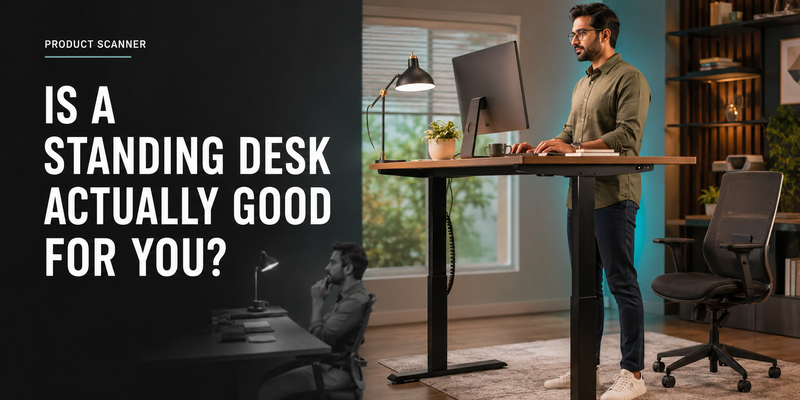
Is a Standing Desk Actually Good for You?
Standing desks are marketed as the antidote to modern office life: better posture, fewer aches, more energy and perhaps even a longer life. That is an impressive list of promises for a desk with a motor.
The reality is less dramatic—but still useful. A height-adjustable desk can help you sit less, change position more often and make a long workday more comfortable. It will not, however, replace walking, exercise or a properly arranged workstation.
Product Scanner verdict: A sit–stand desk can be a worthwhile purchase if you use it to alternate between sitting, standing and moving. A fixed standing desk, or spending the entire day on your feet, is not the healthier solution it is often presented as.
What is a standing desk?
A standing desk positions your keyboard and work surface high enough to use while upright. There are three common types:
-
Fixed standing desks: permanently set at standing height.
-
Desk converters: platforms placed on an existing desk to raise a laptop or monitor.
-
Height-adjustable sit–stand desks: manually or electrically move between seated and standing positions.
For most people, the third option is the sensible one. The real benefit comes from changing posture—not swapping eight hours of sitting for eight hours of standing.
What does the research actually say?
1. Standing desks help people sit less
This is the strongest and most consistent benefit. Research reviews find that sit–stand desks change workplace behaviour and reduce sitting time. A 2025 systematic review concluded that these interventions can reduce sedentary behaviour over short, medium and longer periods.
The size of the effect varies. Some workplace studies report reductions of around 30 minutes a day, while more intensive programmes combining adjustable desks with reminders or coaching have produced larger reductions.
That matters because long, uninterrupted periods of sitting are associated with poorer metabolic and cardiovascular health. But the desk is only a tool: owning one does not guarantee that you will use it.
2. They may reduce back, neck and shoulder discomfort
Changing position can give muscles and joints a break from a single static posture. In one CDC-published workplace project, participants reduced sitting by roughly an hour a day and reported less upper-back and neck pain.
This does not mean a standing desk cures back pain. Discomfort may also come from poor monitor height, an unsuitable chair, weak or overworked muscles, an existing injury or staying in any one position for too long. Evidence reviews generally find that benefits for discomfort are more consistent than improvements in broader health measures, but the results are not universal.
If your pain is persistent, worsening, radiating into an arm or leg, or accompanied by numbness or weakness, a desk purchase is not a substitute for medical assessment.
3. Standing burns only slightly more energy than sitting
Standing requires more muscular activity than sitting, but the difference is small. It is unlikely to produce meaningful weight loss by itself.
A standing desk should therefore not be treated as fitness equipment. A short walk, stair climb or exercise break offers far more movement than simply remaining upright in front of a screen.
4. Productivity usually does not collapse
People often worry that standing will make typing, concentrating or attending calls more difficult. Reviews generally do not show a major negative effect on work performance. Some people report feeling more alert, and active-workstation research suggests that reducing sedentary time need not harm job performance.
The adjustment period can still feel awkward. Detailed writing, design work or tasks requiring fine mouse control may be easier while seated. Calls, reading and routine administrative work are often easier opportunities to stand.
5. Standing all day is not the answer
Prolonged standing can lead to foot and leg fatigue, lower-back discomfort and circulatory problems. Research on occupations involving long periods of standing has associated it with lower-limb symptoms and other health risks.
A large observational study published in 2024 also found that standing for longer did not cancel the cardiovascular risks of an otherwise sedentary lifestyle. Because this type of research cannot prove that standing directly caused every outcome, it should not be read as “standing desks are dangerous.” The practical message is simpler: being stationary for hours—whether seated or standing—is not the goal.
So, is a standing desk good for you?
Yes, potentially—but because it encourages variation, not because standing is inherently healthy.
A sit–stand desk is most useful if you:
-
Work at a desk for several hours each day.
-
Regularly feel stiff after prolonged sitting.
-
Will genuinely change position during the day.
-
Can adjust your monitor, keyboard and desk to fit your body.
-
Understand that movement breaks and exercise are still necessary.
It may be poor value if you expect it to burn significant calories, fix an injury or compensate for an otherwise inactive lifestyle.
How long should you stand?
There is no perfect sit-to-stand ratio that works for everyone. Ignore rigid social-media rules and begin gradually.
A practical starting routine is:
-
Stand for 10–15 minutes after every 45–60 minutes of sitting.
-
Increase standing periods only if you remain comfortable.
-
Take a brief walking or mobility break at least once every hour.
-
Sit down when your feet, calves or lower back begin to fatigue.
-
Change position before discomfort becomes significant.
The best posture is usually your next posture.
How to use a standing desk correctly
Set the desk near elbow height
Your elbows should remain close to your sides, with forearms approximately parallel to the floor. Avoid lifting your shoulders or bending your wrists upward to reach the keyboard.
Keep the screen at a comfortable height
Position the monitor directly in front of you, roughly an arm's length away. The top of the screen should generally be at or slightly below eye level. Laptop users will usually need a separate keyboard and mouse to achieve both a comfortable screen height and neutral wrist position.
Avoid locking your knees
Stand naturally, keep your knees relaxed and shift your weight occasionally. A small footrest can help you alternate which foot is supported.
Wear supportive footwear
Hard flooring and unsupportive footwear can make standing uncomfortable quickly. An anti-fatigue mat may improve comfort, although it does not make prolonged standing risk-free.
Keep a proper chair
Buying a standing desk does not make your chair irrelevant. You still need a supportive, adjustable chair for the seated part of your day. Your feet should rest flat on the floor or on a footrest, with your keyboard and screen positioned comfortably.
What should you look for when buying one?
Height range
The desk must go low enough for comfortable sitting and high enough for standing without shrugging your shoulders. Published minimum and maximum heights are more important than whether the product is labelled “ergonomic.”
Stability
A desk can look solid in photographs yet wobble noticeably at standing height. Check independent reviews at the height you expect to use, particularly if you have a large monitor or use a monitor arm.
Weight capacity
Add the approximate weight of your tabletop, monitors, computer, speakers and accessories. Leave a reasonable margin below the desk's maximum rating.
Adjustment speed and noise
Electric adjustment is more convenient when you switch positions several times a day. A slow or noisy motor can discourage frequent use, especially in a shared room.
Memory presets
Preset buttons are genuinely useful rather than decorative. One saved sitting height and one standing height remove the friction of adjusting the desk repeatedly.
Desktop depth
A deeper surface makes it easier to keep the monitor at a comfortable viewing distance. Cable management also matters because cables must have enough slack to move safely through the desk's full height range.
Warranty and service
For an electric desk, examine the warranty on the frame, motor and electronics—not only the tabletop. In India, accessible after-sales support and spare parts can be more important than an unusually long warranty printed on a marketplace listing.
Standing desk vs desk converter
A converter is cheaper and suitable for testing whether you enjoy standing while working. However, it occupies desk space, may create a raised keyboard platform even when seated and can be less stable.
A full sit–stand desk costs more but generally offers a larger surface, cleaner ergonomics and easier switching. If you work from home permanently and already know you will use it, the complete desk is usually the better long-term product.
Frequently asked questions
Can a standing desk help you lose weight?
Not meaningfully on its own. Standing burns only modestly more energy than sitting. Diet, walking and structured exercise have a much larger effect.
Is a standing desk good for back pain?
It may reduce discomfort for some users by allowing posture changes, but it is not a treatment for every cause of back pain. Correct setup and regular movement remain important.
Is standing for eight hours healthier than sitting?
No. Prolonged standing can also cause fatigue and discomfort. Alternate between sitting, standing and moving.
Do you need an anti-fatigue mat?
Not necessarily, but it may improve comfort on hard floors. Supportive footwear and sensible standing duration matter just as much.
Are manual or electric desks better?
Manual desks are cheaper and have fewer components that can fail. Electric desks are quicker to adjust and more convenient, making users more likely to change position regularly.
Final verdict
A height-adjustable standing desk is a useful ergonomic tool, not a health miracle. Its main advantage is that it makes changing posture easy. Used well, it can reduce sitting time and may improve comfort without hurting productivity.
Do not buy one to stand all day. Buy one if it will help you sit, stand, walk and move more naturally throughout the day. The motor is convenient; the movement is what matters.