
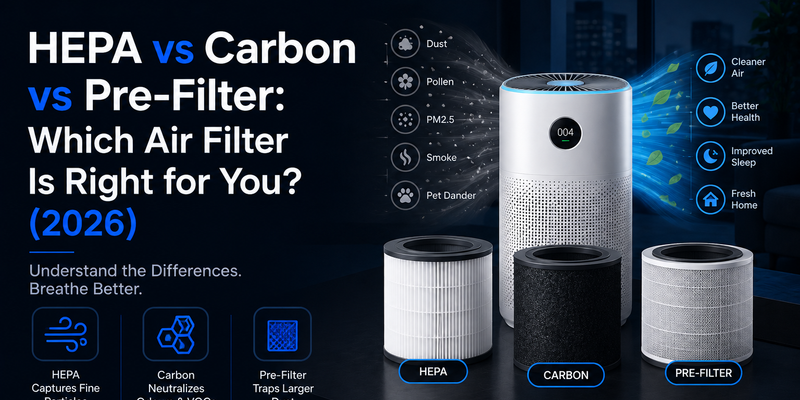
If you are looking for the best air purifier for your home, it is easy to get distracted by brands, smart features and increasingly complicated filter names.
The more useful question is much simpler:
What actually makes an air purifier effective?
For most people, the answer comes down to five things: the size of your room, the purifier's clean air delivery rate, its filtration system, how often you can realistically run it, and how much it costs to maintain.
A ₹10,000 air purifier can be a better choice than a ₹30,000 model if it is correctly sized for your room, has enough airflow and has affordable replacement filters.
Here is what to look for before you buy.
1. Start With Your Room Size
The first mistake people make is choosing an air purifier based on the brand rather than the room.
Measure the room first.
Multiply the length by the width to get the approximate floor area.
Example
12 ft × 12 ft = 144 sq ft
Now compare that room with the purifier's recommended coverage area and, more importantly, its clean air delivery rate (CADR).
A purifier designed for a small bedroom may work very well in that room but be underpowered in a large living room or open-plan area.
The larger the area, the more air needs to be processed.
2. What Is CADR?
CADR stands for Clean Air Delivery Rate.
It is one of the most useful specifications when comparing portable air purifiers because it combines airflow with particle-removal performance.
Put simply, CADR helps answer:
How much cleaned air can this machine deliver?
A higher CADR generally means that a purifier can clean a larger space or clean the same space more quickly.
The US Environmental Protection Agency recommends selecting a portable air cleaner with a CADR appropriate for the size of the room. Its guidance also notes that higher fan speeds and longer operating times generally increase the amount of air filtered.
This is why the phrase "covers 500 sq ft" should not be the only thing you compare.
Look for the actual CADR as well.
3. Why HEPA Matters
HEPA stands for High Efficiency Particulate Air.
HEPA filtration is primarily relevant to airborne particles.
Depending on the exact filter and system, particle filtration can help reduce airborne dust, pollen and fine particulate matter.
But there is an important distinction:
A HEPA filter is only one part of an air purifier
You also need enough airflow.
A small machine with an excellent filter but insufficient airflow for a large room is not automatically a better choice than a properly sized purifier with an appropriate CADR.
Think of it this way:
Filter efficiency × airflow = useful filtration.
4. What Does a Carbon Filter Do?
HEPA and activated carbon are designed for different jobs.
A particle filter targets airborne particles.
Activated carbon is commonly used to help remove gases and odours.
This matters if you are dealing with things such as cooking smells, tobacco smoke or certain volatile organic compounds.
But do not assume that a purifier is highly effective at gas removal simply because the product page contains the words "activated carbon."
The amount of carbon matters.
A very thin carbon coating is not necessarily equivalent to a substantial carbon filter.
If odour or gas filtration is important to you, look beyond the words on the box.
5. Don't Forget the Pre-Filter
Many air purifiers start with a pre-filter.
Its job is to catch larger particles such as hair, fibres and larger dust particles before the air reaches the finer filter.
This helps protect the main filtration stage and makes maintenance easier.
Some pre-filters are washable or designed to be cleaned periodically.
That can be useful if you live in a dusty environment or have pets.
A dirty pre-filter can also restrict airflow, so maintenance should not be treated as optional.
6. Check Replacement-Filter Costs Before Buying
This is one of the most important buying considerations—and one of the most frequently ignored.
The purchase price is only the beginning.
You will eventually need replacement filters.
A purifier that costs ₹8,000 but requires an expensive replacement filter every year may end up costing more over several years than a ₹12,000 purifier with a longer-lasting or cheaper filter.
Before buying, check:
-
Replacement-filter price
-
Expected replacement interval
-
Availability in India
-
Whether replacement filters are sold independently
-
Whether the brand has a reliable local support network
Do not buy an air purifier without checking whether you can actually source its filters later.
7. How Important Is Noise?
For a living room, noise may be a minor consideration.
For a bedroom, it can determine whether you use the purifier at all.
Manufacturers sometimes quote their lowest possible noise level, while the purifier becomes considerably louder at higher fan speeds.
That is why "silent mode" alone does not tell you much.
Ask yourself:
What fan speed am I realistically going to use?
If the answer is low speed because the higher settings are too noisy, the purifier's real-world performance will differ from its maximum specification.
8. Think About Energy Use
Air purifiers work best when they are actually running.
That makes electricity consumption relevant.
Instead of looking only at wattage, compare how much air the machine can clean relative to the energy it consumes.
ENERGY STAR uses an efficiency metric that relates clean air delivery to energy use.
For Indian households, this matters particularly if you expect to run the purifier for many hours each day during periods of poor outdoor air quality.
9. Be Careful With "Advanced Purification" Claims
The air-purifier market is full of terms such as:
-
"Ionisation"
-
"Plasma"
-
"Nano"
-
"Electrostatic"
-
"Active purification"
Some technologies have legitimate applications, but a more complicated feature list does not automatically mean better air cleaning.
Watch for ozone claims
One issue worth paying attention to is ozone.
The EPA advises avoiding portable air cleaners that intentionally produce ozone because ozone can irritate the lungs.
That makes conventional filtration with clearly disclosed specifications easier to evaluate.
10. Smart Features Come Later
Wi-Fi control is convenient.
Air-quality sensors are convenient.
Automatic modes can be convenient.
But none of them should be your first selection criterion.
A sensible buying hierarchy
-
Correct room size
-
CADR
-
Particle filtration
-
Carbon filtration if needed
-
Replacement-filter cost
-
Noise
-
Energy consumption
-
Smart features
Start with performance. Add convenience afterward.
Producter Hunter Pick: Coway Airmega 150
For a medium-sized room, the Coway Airmega 150 is an interesting option to evaluate because it combines a washable pre-filter, carbon filtration and HEPA filtration in a dedicated room air purifier.
Coway positions the model for rooms up to approximately 355 sq ft in India.
It is particularly worth considering for buyers who want a straightforward filtration-focused machine rather than a product overloaded with unnecessary features.
Before purchasing, check the current Amazon India price and replacement-filter availability because both can change.
Best suited for
Bedrooms, smaller living rooms and medium-sized enclosed rooms.
What to verify before buying
Current price, replacement-filter cost, current stock and manufacturer specifications for your room size.
Frequently Asked Questions
What Is the Best Air Purifier for a Bedroom?
Choose one that is correctly sized for the room and quiet enough to operate for extended periods.
A purifier with a high maximum CADR is not necessarily the best bedroom purifier if you end up running it only on its lowest setting because of noise.
What Is the Best Air Purifier for Dust?
Look for strong particle filtration and sufficient CADR.
If your main concern is airborne dust and fine particulate matter, particle-filtration capability should take priority over decorative features.
Remember that an air purifier does not remove dust that is already sitting on your furniture or floor.
It filters particles that are airborne and pass through the machine.
Is an Expensive Air Purifier Better?
Not necessarily.
Price is not a performance metric.
Compare CADR, filtration, maintenance, noise and total cost of ownership.
A cheaper purifier that is correctly sized and consistently used can be a more sensible purchase than a premium machine that is oversized, expensive to maintain or rarely operated.
Final Verdict
The best air purifier for your home is not necessarily the most powerful machine or the most famous brand.
It is the purifier that is correctly sized for your space, moves enough air, uses an appropriate filtration system, can run comfortably for long periods and has filters you can afford to replace.
Start with the room.
Then compare CADR.
Then look at filtration.
Then look at the long-term cost.
That order will get you much closer to the right air purifier than starting with the brand name.