
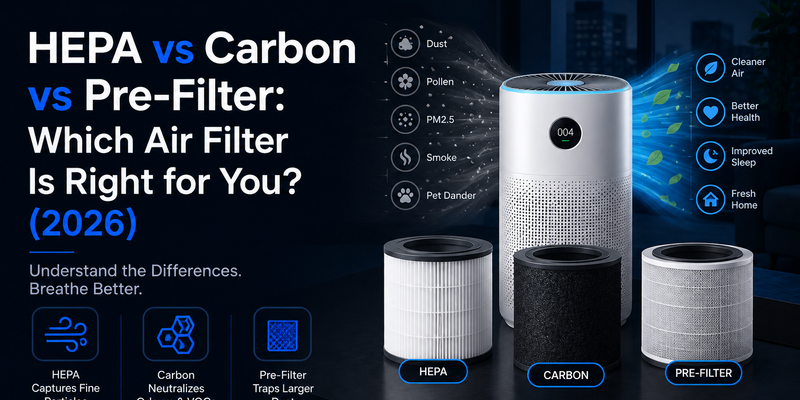
When you shop for an air purifier, the filter specifications can be more confusing than the purifier itself.
You will see terms such as HEPA, H13 HEPA, activated carbon, pre-filter, nano filter and multi-stage filtration across brands like Coway, Philips, Honeywell, Dyson and Xiaomi.
But which one actually matters to you?
The answer depends on what you are trying to remove from your air.
HEPA Filter: Best for Dust and PM2.5
If your main concern is dust, PM2.5, pollen or other airborne particles, start with the particle filter.
HEPA filters are designed to capture very small airborne particles that pass through the filter.
This is why brands such as Coway, Philips, Honeywell and Dyson prominently feature HEPA or high-efficiency particle filtration in many of their air purifiers.
But don't stop at the word "HEPA."
Your purifier still needs enough airflow
A HEPA filter can be highly efficient, but if the purifier moves very little air, it will not clean a large room quickly.
When comparing products, look at:
-
HEPA filter specification
-
CADR
-
Recommended room size
-
Replacement-filter cost
For a polluted bedroom or living room, HEPA + adequate CADR is usually a more useful combination than simply buying the purifier with the fanciest filter name.
Activated Carbon: Best for Odours and Some Gases
Activated carbon does a different job.
It is used to adsorb certain gases and odours, making it useful if you are dealing with:
-
Cooking smells
-
Tobacco smoke
-
Pet odours
-
Certain VOCs
You will find carbon filtration across products from brands such as Coway, Honeywell, Philips and Xiaomi.
But there is a catch
Simply saying a purifier has a "carbon filter" does not tell you how effective it is.
The amount of activated carbon matters.
A thin carbon coating is not the same as a substantial carbon filter.
So, when comparing two products, don't just ask:
"Does it have carbon?"
Ask:
"How much carbon does it use, and what does the manufacturer actually claim it removes?"
Pre-Filter: The Filter You Should Not Ignore
The pre-filter is usually the first stage.
It catches larger particles such as:
-
Hair
-
Pet fur
-
Fibres
-
Larger dust particles
This protects the finer filter and can help extend its useful life.
A pre-filter is particularly useful if you have pets, children or a dusty home.
Many brands use washable or cleanable pre-filters, although the exact design varies by model.
Why it matters for you
Imagine you live in Delhi during a dusty winter and your purifier is running every day.
The more dust and hair the machine encounters, the more important pre-filter maintenance becomes.
A clogged pre-filter can also restrict airflow.
So don't think of it as a minor "first layer." It helps the rest of the system work properly.
HEPA vs Carbon vs Pre-Filter
| Filter | What it is mainly for | What you should look for |
|---|---|---|
| Pre-filter | Hair, larger dust, fibres | Easy cleaning |
| HEPA / particle filter | Dust, PM2.5, pollen | Filter specification + CADR |
| Activated carbon | Odours, some gases | Amount of carbon |
The best air purifier may use all three.
That is why many popular models from Coway, Honeywell and Philips combine a pre-filter, particle filter and carbon stage.
What About "Nano" and "Multi-Stage" Filters?
This is where air-purifier marketing can become confusing.
A purifier advertised as having "5-stage" or "7-stage" filtration is not automatically better than one with three stages.
You need to know what those stages actually do.
For example:
Pre-filter + HEPA + carbon
is much easier to understand than:
Nano + ionisation + plasma + proprietary purification + antibacterial layer
More stages do not automatically mean more useful filtration.
Similarly, words like "nano" are not a substitute for measurable specifications such as CADR and particle-filtration performance.
Which Brands Use What?
Several major brands follow broadly similar filtration principles, even though their designs differ.
Coway
Coway models such as the Airmega 150 combine pre-filtration with particle and carbon filtration.
Philips
Philips' air purifiers commonly combine particle filtration with additional filtration for gases and odours, depending on the model.
Honeywell
The Air Touch V2 uses a pre-filter, H13 HEPA filtration and activated carbon.
Dyson
Dyson's air purifiers combine high-efficiency particle filtration with activated carbon in several models, while also adding extensive sensing and automatic-control features.
Xiaomi
Xiaomi offers multiple purifier models using high-efficiency particle filtration, with specifications varying by model and generation.
The important takeaway is that brand alone does not tell you which purifier is right for your room.
Compare the actual model.
What Should You Buy?
Your choice should start with your problem.
You mainly want to reduce PM2.5 and dust
Look for:
HEPA/high-efficiency particle filtration + strong CADR
You mainly want to reduce smells
Look for:
Activated carbon
You have pets
Look for:
A good pre-filter + particle filtration
You want general-purpose filtration
Look for:
Pre-filter + HEPA/high-efficiency particle filter + meaningful carbon stage
Producter Hunter Pick: Honeywell Air Touch V2
If you want a straightforward multi-stage purifier, the Honeywell Air Touch V2 is a useful model to consider.
Its published specification combines:
-
Pre-filter
-
H13 HEPA filtration
-
Activated carbon filtration
That gives you a straightforward combination of filtration stages rather than relying heavily on proprietary terminology.
Before buying, check the current Amazon India price, replacement-filter availability and whether its CADR suits your room.
Best for: Medium-sized rooms and buyers looking for particle + carbon filtration.
Frequently Asked Questions
Is HEPA better than activated carbon?
Neither is universally better.
HEPA is mainly for airborne particles, while activated carbon is used for gases and odours.
Do I need both HEPA and carbon?
For general home use, a combination can be useful because the two filters target different pollutants.
Is a 5-stage purifier better than a 3-stage purifier?
Not necessarily.
Look at the actual filtration technologies, CADR and maintenance costs instead of counting stages.
Is a nano filter better than HEPA?
Not automatically. "Nano" is a technology term, not a universal performance rating.
Which filter matters most for PM2.5?
A strong particle-filtration system and adequate CADR are the most important things to compare.
Final Verdict
Don't buy an air purifier because the box says "7-stage filtration."
Buy it because the filtration matches your problem.
For dust and PM2.5, prioritise HEPA/high-efficiency particle filtration and CADR.
For smells, look for meaningful activated carbon.
For hair and larger dust, a good pre-filter matters.
And before choosing between Coway, Philips, Honeywell, Dyson or Xiaomi, compare the actual model—not just the brand name.